Recent work. Each one names the goal, the workflow, and the result. No required sequence.
Examples
identifying future trial patient populations
The population the plan was built on did not exist as a clinical category.
Work duration: 1 day
identifying future trial patient populations
The population the plan was built on did not exist as a clinical category.
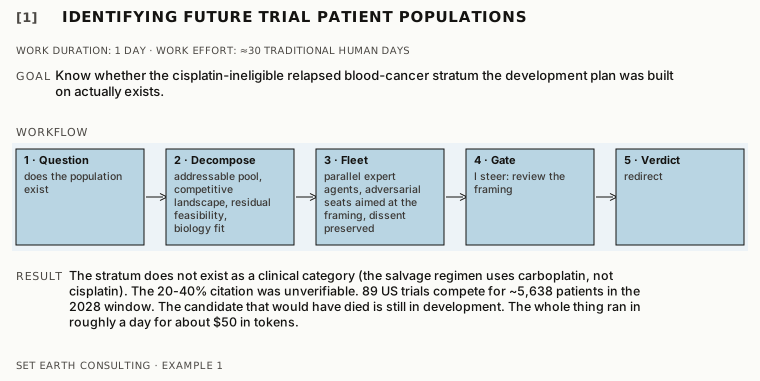
The goal. Know whether the population the development plan was built on actually exists, before the money runs out — a relapsed blood-cancer "cisplatin-ineligible" stratum.
The workflow. Broke the question into parts: total addressable pool, competitive trial landscape, residual feasibility, biology fit. Parallel expert agents worked the sub-questions independently; adversarial seats were pointed at the framing itself (the population definitions, the plan's own assumptions); dissent was preserved in the final deliverable. The whole thing ran in roughly a day for about fifty dollars in tokens.
The result. The stratum does not exist as a recognized clinical category: the salvage regimen the framing assumed uses carboplatin, not cisplatin, so "cisplatin-ineligible" sorts patients by their tolerance of a drug they were never going to get. The 20–40% citation supporting it was unverifiable. The pool alone had 89 US trials competing for roughly 5,638 patients in the 2028 window. The prediction was precise and wrong. The error was in the framing. The candidate that would have died is still in development. A comparable vendor engagement takes months.
Full write-up: Using AI to predict clinical trial patient populations.
a plant KPI board in three days
A manufacturing client's planning session became a board their team could click through.
Work duration: 3 days
a plant KPI board in three days
A manufacturing client's planning session became a board their team could click through.
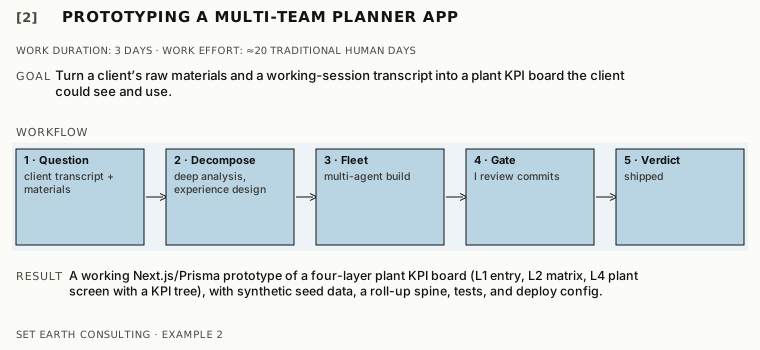
The goal. Turn a manufacturing client's raw materials and a working-session transcript into the plant KPI board their team could see and use.
The workflow. Multi-agent deep analysis of the transcript and materials; experience design; a verbatim plan; a local builder with roborev-reviewed commits.
The result. A working prototype of a four-layer plant KPI board: L1 entry, L2 matrix, L4 plant screen with a KPI tree, a roll-up spine from entry to plant screen, synthetic seed data, tests, and deploy config. Built on Next.js and Prisma.
the agents filed the patent assignments
Agents drove the browser through the actual USPTO filing.
Work duration: 1 day
the agents filed the patent assignments
Agents drove the browser through the actual USPTO filing.
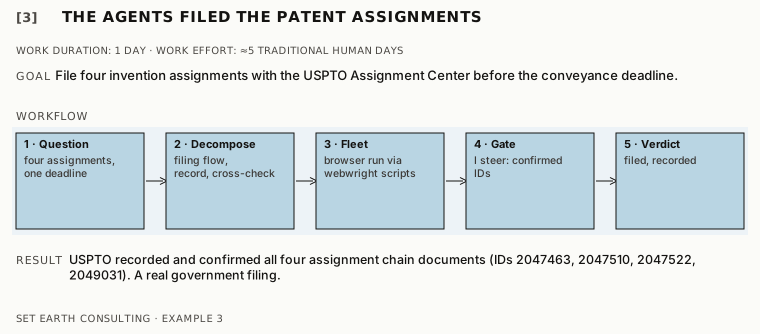
The goal. File four invention assignments with the USPTO Assignment Center before the conveyance deadline.
The workflow. Agents drove the browser through the filing flow with webwright scripts, then wrote the filing record and cross-checked stale claims in the client-facing docs.
The result. All four assignment chain documents were recorded and confirmed (IDs 2047463, 2047510, 2047522, 2049031). A real government filing.
setting up Notion for multi-human+agent work
A half-built CRM became the operating layer; interactions went 73→316.
Work duration: 4 days
setting up Notion for multi-human+agent work
A half-built CRM became the operating layer; interactions went 73→316.
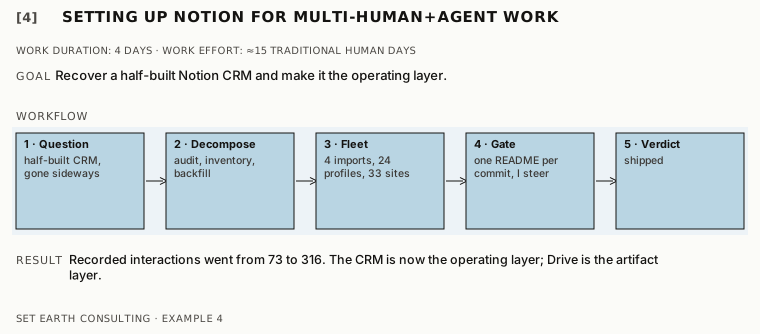
The goal. Recover a half-built Notion CRM that had gone sideways and make it the operating layer.
The workflow. Audit of what was there; Drive/Notion inventories; four missing meetings imported; 24 person profiles and 33 org websites backfilled; then a three-phase interaction backfill (org links, Gmail via msgvault, calendar import). Each phase landed as its own commit with a README.
The result. Recorded interactions went from 73 to 316. The CRM is now the operating layer; Drive is the artifact layer.
a conversation to a deck in two days
Two days from transcript to message architecture, deck, export, and buildout plan.
Work duration: 2 days
a conversation to a deck in two days
Two days from transcript to message architecture, deck, export, and buildout plan.
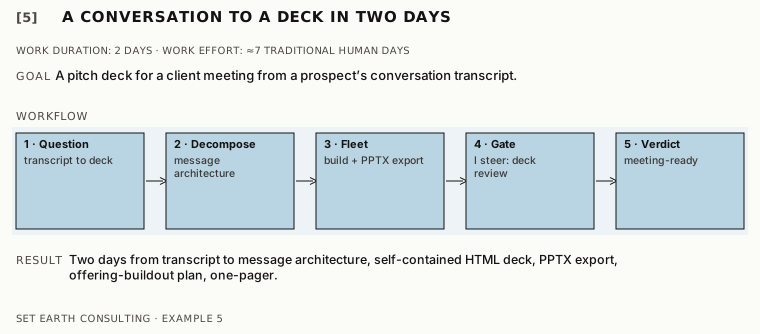
The goal. A pitch deck for a client meeting from a prospect's conversation transcript.
The workflow. Transcript read; message architecture; self-contained HTML pitch deck; PPTX export; an offering-buildout plan plus one-pager.
The result. Two days from transcript to message architecture, self-contained HTML deck, PPTX export, offering-buildout plan, one-pager.
identifying a new market and GTM strategy
A four-seat runtime ensemble produced a Thursday-ready plan in one session.
Work duration: 1 day
identifying a new market and GTM strategy
A four-seat runtime ensemble produced a Thursday-ready plan in one session.
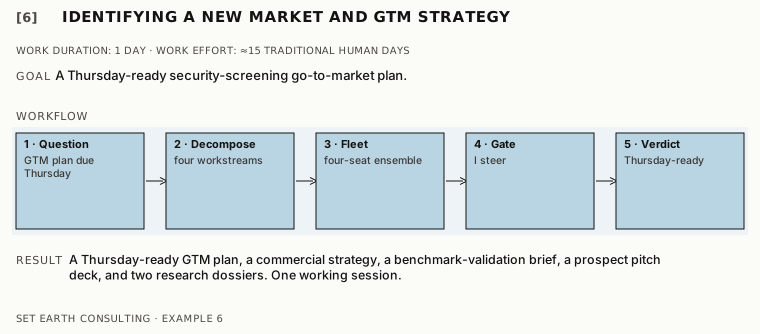
The goal. A Thursday-ready security-screening go-to-market plan.
The workflow. One session: a four-seat runtime ensemble (GTM architect, target-intel researcher, AI-lab specialist, adversarial buyer) synthesized the plan, a commercial strategy, and a benchmark-validation brief, while two spawned subagents produced benchmark research dossiers in parallel.
The result. A Thursday-ready GTM plan, a commercial strategy, a benchmark-validation brief, a prospect pitch deck, and two research dossiers — one working session.
tech transfer office cross domain reporting
A stalled 449-line compliance packet was cut 34% to a sendable client packet.
Work duration: 1 day
tech transfer office cross domain reporting
A stalled 449-line compliance packet was cut 34% to a sendable client packet.
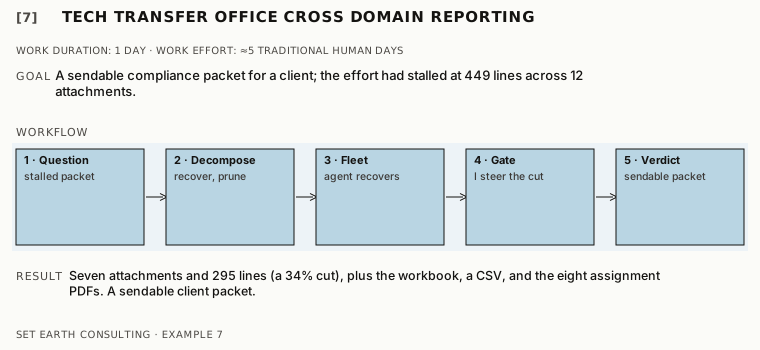
The goal. A sendable compliance packet for a client; the effort had stalled at 449 lines across 12 attachments.
The workflow. An agent session recovered the stalled effort, then pruned the packet to what the client actually needs.
The result. Seven attachments and 295 lines — a 34% cut — plus the workbook, a CSV, and the eight assignment PDFs. A sendable client packet.
this practice, from nothing
The strategic spine plus two panels shipped in one session; this site runs on it.
Work duration: 1 day
this practice, from nothing
The strategic spine plus two panels shipped in one session; this site runs on it.
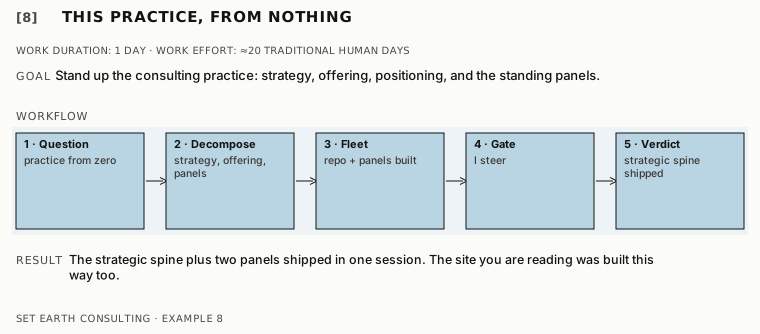
The goal. Stand up the consulting practice: strategy, offering, positioning, and the standing panels that pressure-test it.
The workflow. One agent session: repo init; AGENTS.md, CONTEXT.md, README, STRATEGY, MENTAL_MODEL; the retainer architecture rewritten to a 3×$15k project-arc model; two runnable multi-agent panels built and run (practice-development — seven specialist seats plus an adversarial seat; draft-red-team — which produced the buyer-tested network note). About twelve commits.
The result. The strategic spine plus two panels shipped in one session. The site you are reading was built this way too.
the panel caught our own reasoning
An adversarial panel surfaced a P0 in the team's own reasoning before it got filed.
Work duration: 1 day
the panel caught our own reasoning
An adversarial panel surfaced a P0 in the team's own reasoning before it got filed.
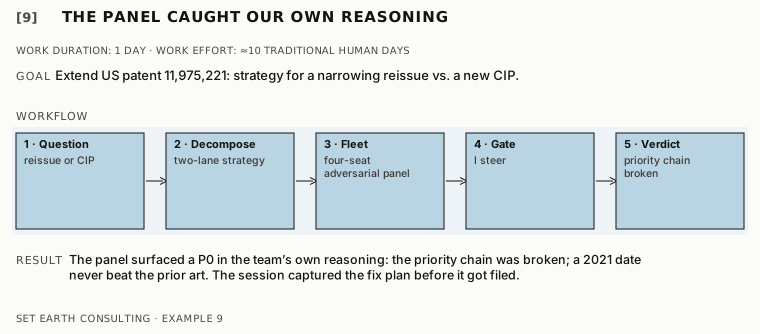
The goal. Extend US patent 11,975,221 — strategy for a narrowing reissue vs. a new CIP.
The workflow. Two-lane strategy; a four-seat adversarial panel (prosecution strategist, competitive IP analyst, standards technologist, commercial strategist); a reboot-proof snapshot and durable task graph.
The result. The panel surfaced a P0 in the team's own reasoning: the priority chain was broken — a 2021 date never beat the prior art. The fleet does not accept my reasoning by default. The session captured the fix plan before it got filed.
the FDA 510(k) pipeline
The FDA 510(k) submission is assembled by a standing pipeline.
Work duration: 1 day
the FDA 510(k) pipeline
The FDA 510(k) submission is assembled by a standing pipeline.
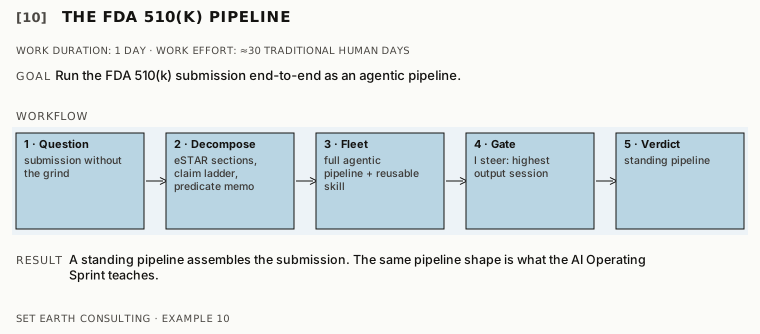
The goal. Run the FDA 510(k) submission for the device end-to-end as an agentic pipeline, not a document grind.
The workflow. Designed and executed the full agentic pipeline: eSTAR sections, claim ladder, predicate memo, persona harness, gap register, terminology audit, RFQ arm quotes, GWU catch-up packet, patent docket first-pass — the highest code/commit-output session in the window. The process itself was captured as a reusable skill (SKILL.md plus ten templates) and a workgraph, and a 611-line 505(b)(2) process specification landed in the Navicyte repo.
The result. A standing pipeline assembles the submission. The same pipeline shape is what the AI Operating Sprint teaches: context, task, execution, and a handoff I can inspect.
the multi-player outreach engine
Three divergent outreach lanes became one canonical, lane-aware engine with shared safety layers.
Work duration: 20 days
the multi-player outreach engine
Three divergent outreach lanes became one canonical, lane-aware engine with shared safety layers.
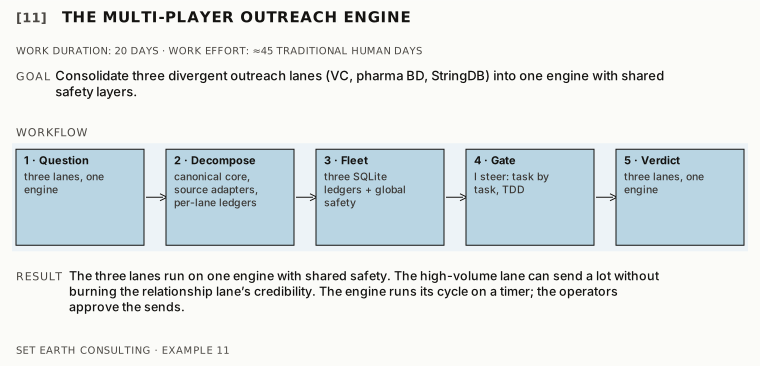
The goal. Consolidate three divergent outreach lanes — VC, pharma BD, and StringDB — into one canonical, lane-aware, multi-operator engine with shared safety layers, then retire the superseded work.
The workflow. One canonical core (`market_research/synthyra-outreach/`); three lanes plug in via source adapters plus per-lane template sets; three per-lane ledgers (SQLite, shared schema) isolate the high-volume StringDB firehose from the relationship-sensitive pharma BD threads; one global suppression/bounce store plus one global CRM dedupe guard enforce multiplayer safety; operators are first-class (identity config drives signatures, from addresses, and Gmail credentials); CRM access abstracted behind an adapter (Graph CRM now, OSS Twenty target). Built task-by-task under a plan with single-writer discipline, TDD, and archive-based retirement. The session evidence: 114 user turns, 308 write calls, and 66 commit calls between 2026-08-11 and 08-31.
The result. The three lanes run on one engine with shared safety. The high-volume lane can send a lot without burning the relationship lane's credibility, and the dedupe and suppression guards keep multiplayer reputation safe. The engine runs its cycle on a timer. The operators approve the sends.